GLEN COVE, N.Y., Feb. 9— The year began here much the way last year did: with the wind whistling through downtown streets empty except for groups of shabby men walking aimlessly about with little more in their pockets than their fists.
Across from City Hall, Stan Eisenstadt, 75, and his son Bob, 47, waited for customers in their hardware store. Everything was marked down 50 percent, but still nobody came. After four decades in the business and facing a bleak future, the Eisenstadts have sold their corner lot to a developer and plan to close this month.
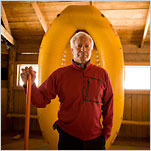
Up the hill, among the duck ponds and the naked sycamores, Paul G. Pennoyer, 78, a grandson of J. Pierpont Morgan, listened as the earth movers felled trees to make way for the new houses being built across the glade, a place where his family once held fox hunts and shooting competitions.
''It makes me sad to see what's happening in Glen Cove,'' Mr. Pennoyer said. ''But I'm not weeping over it. I can't stop it.''
Originally the exclusive province of wealthy industrialists and robber barons, Glen Cove was and still is considered the capital of the Gold Coast, a place where the rich spent their summers before anyone had heard of the Hamptons. Morgan built his estate here. So did the oil barons Charles Pratt and Stephen V. Harkness. F. W. Woolworth built his palace next to theirs.
But the butlers and the lavish parties are memories. Some estates were torn down to make way for glorified subdivisions, and those that remain are now museums, conference halls and university buildings. With the opulence gone, few tourists visit this enclave on Hempstead Harbor. Downtown is half empty, and one of the most conspicuous features on the streets are the clusters of Central American laborers waiting for work.
Glen Cove is in the midst of its post-suburban life. Its population of 25,000 has become a gumbo of the rich, the middle class, the poor and the downright poor. With impoverished immigrants knocking at its door and the small businessman walking out of it, old-timers here wonder whether the golden luster of Glen Cove can ever be reclaimed.
The Mayor and city elders are optimistic about its renewal, with some justification. They have their flip charts and waterfront-development proposals, and boast about the new government buildings downtown. But that they are talking about urban revitalization in one of America's original suburbs shows just how far the city has spilled into Nassau County.
''It's become a strange place, more like New York City than Nassau County,'' said Roger Wunderlich, a professor of Long Island history at the State University at Stony Brook. ''It went from rural to exclusive to mainstream to a time now where the mom and pop mainstream are having trouble surviving.
''You have welfare people living near the very rich. You have housing issues and elderly people and homelessness. There is a large minority population and the city seems unwilling or unable to come to grips with its real social problems,'' Professor Wunderlich said.
Even the Mayor, Thomas R. Suozzi, a man who is rabid about Glen Cove's image, concedes the point. ''It's true, we are a suburban town with city problems,'' he said.
But Mayor Suozzi has a vision for his city and eagerly heralds his accomplishments since taking office five years ago. There is the new City Hall-police station-courthouse complex. He closed down the incinerator. A software designer has set up operations in Glen Cove, and a shabby patch of land that sat barren for 20 years in the middle of downtown has recently been sold to a developer.
His most ambitious plan is a $250 million renewal of the waterfront, transforming it from a hazardous waste site into a seaport and marina to rival those in New York City, Connecticut and Rhode Island.
''This is the Gold Coast, and we want to capitalize on that,'' he said, dirtying his polished shoes in waterfront mud. ''Imagine hundreds of people docked here, eating oysters in the restaurants, listening to music on the waterfront.''
Yet the waterfront is miles away from a major highway, and little has been done on the project, his critics contend, calling it a thin sheet masking Glen Cove's more serious needs. They laugh at the Regina Maris, the 90-year-old barkentine that was thought to have helped rescue Danish Jews during World War II.
Last summer, the Mayor welcomed her to the city as a symbol of his efforts to revitalize the waterfront. But last week, officials announced that the vessel may have hauled rocks during the war, but never refugees. She now rests in the mud of Hempstead Harbor, taking on water, drawing more titters than tourists.
''We get a lot of fluff but little substance,'' said John Maccarone, a city councilman. ''The point here is the small businessman is leaving downtown and little is being done to help him now.''
The decay of the village center is a problem that plagues much of Long Island, said Dr. Lee E. Koppelman, executive director of the Long Island Regional Planning Board. Unable to compete with the super malls and strip developments along nearby highways, small shops are packing it in. And though some bigger businesses have come to Glen Cove, the city has few answers on how to help its independent businesses. ''It's a slide that started 30 years ago, and I'm not sure that we have bottomed out,'' Dr. Koppelman said.
To resuscitate themselves, small villages developed attractions to draw people. Port Jefferson's waterfront and harbor face lift has been successful. Bay Shore is planning an aquarium.
Yet Glen Cove already has the attractions: the waterfront, three public beaches, a yacht club, parks and, of course, the mansions; like Woolworth's Winfield, where the grand marble staircase cost $2 million to build in 1916.
Until Mr. Suozzi came along, no one thought to stitch it all together and invite the outside public. Instead the waterfront rotted away, and many mansions fell to the ground.
One was Mr. Pennoyer's boyhood home, one of several estates that Morgan built for his children. The other morning, Mr. Pennoyer sat in front of his stone hearth, offering recollections of his grandfather's mansion at the tip of the peninsula, where the surrounding waters provided an anchorage for Morgan's black yacht, Corsair. Besides marble and caviar, his grandfather imported Italians to do his labor and tend to his and his children's estates.
''My father said when Glen Cove was incorporated into a city back in the 20's, city problems would follow,'' Mr. Pennoyer said.
Mr. Pennoyer now lives with his wife in the former horse stable of his parents' 100-acre estate. Just 15 acres remain in the family now, and houses are going up all around them. Some men in tattered clothes sleep in their woods.
''The only immigrants there used to be here were the people who worked in the houses,'' he said. ''They came in old jalopies. Now there are just too many of them. There is crowding in the streets, in the houses, people sleeping in the woods. I have sympathy, but we need to stem the inflow.''
In the south of Glen Cove is a neighborhood known as the Orchard, once the Italian enclave, now rapidly becoming a ghetto of overcrowded houses occupied by young men from Central America. There are hundreds here now, and hundreds more come during summer to mow the lawns and rake the leaves of Glen Cove's wealthy residents.
Some of them live 16 to a house; others sleep in the elements. One man froze to death a few years ago.
The city is unwilling to build a shelter for the homeless, because, the feeling is, if you build it more will come.
''People here are concerned with real estate values, not homeless shelters,'' said the Rev. Patricia B. Mitchell, who retired as the pastor of the First Presbyterian Church in January. ''It is true that if you build shelters, others will be attracted to them. That's why we have shelters for animals and not for people in Glen Cove. That doesn't mean there isn't a need for one.''
The Mayor and the City Council say that they can appreciate the struggle of the day laborers, and that some services are provided, within reason.
''Basically, they are here illegally, and we do what we can for them,'' Mr. Suozzi said. ''But a homeless shelter is permanent substandard housing and is not an answer.''
''Besides, there are a lot of other people in this town. There are legal citizens that I have to worry about, too.''
On School Street downtown, Stan Eisenstadt spent the afternoon drooping over his cash register. Next to him is a picture of the Navy frigate he served on 55 years ago. He is too depressed to say much.
His son Bob, who is overseeing the hardware store liquidation, spoke for him.
''My dad spent his whole life building this hardware store, and it hurts him to close the book.''
Photos: On the North Shore, downtown Glen Cove has more ''for sale or lease'' signs than pedestrians these days. Paul G. Pennoyer, J. P. Morgan's grandson, said, ''It makes me sad to see what's happening.'' (Photographs by Vic DeLucia/The New York Times)(pg. B1); Stan Eisenstadt, 75, and his son Bob, 47, waiting for customers at a liquidation sale in their hardware store. After four decades, the Eisenstadts have sold the Glen Cove store's corner lot and plan to close this month. (Vic DeLucia/The New York Times)(pg. B8) Map of New York showing location of Glen Cove: Glen Cove was the province of rich industrialists and robber barons. (pg. B8)