How to charge or add
Freon or Refrigerant to your
Air conditioner or Heat pump.
The following material is somewhat
controversial. There are many who would like to make sure that the average
homeowner will never work on their own equipment and the industry has gone to
great lengths to get the government to regulate the use of refrigerants by the
average person. In short blame the last person that you voted for who got
elected to office. If you want to learn more about law here is a good fun place to start.
I will not discuss the legality of handling
refrigerants please take that
up with the appropriate authorities. I will simply be telling you how to know if
your system needs refrigerant and how to know how much to put in. But surf-ice
it to say that there is a correct amount of refrigerant that should be in your
system and adding any more will not make it work any better but will cause
damage.
On a recent showing of "Dateline
NBC" they set up 8 companies in the Houston Texas area. After checking
out this Trane system thoroughly they let each company look at it and every one
either added 2 pounds of R22 or said it needed 2 pounds. by the time they were
done this system had over 4 pounds (that is what they reported it could be more)
of excess refrigerant in addition to what was already in there. I can understand
the first charge but after that the head pressure on that system must have been
over 300 psi and by the end of the show the system must have been over 400 (the
compressor should have gone off on internal relief). I am guessing that is why
they chose to use a Trane or American Standard system. That just goes to show
how crooked this trade has become.
My Definitions:
Charge: The amount of
refrigerant that should be in a system to make it work when everything is
functioning.
Metering: The process of feeding refrigerant into the
evaporating portion of an air conditioning or heat pump system. You can have a
system that is properly charged and mot metering correctly. There will be no
procedure of changing the charge to make it work correctly.
Do not confuse the two.
Just about every one is familiar with a
gauge manifold, it is those two gauges that have hoses coming out that everyone
who has ever done any refrigeration work has. There are two gauges on that
manifold one for low pressure (also known as suction) one for high pressure
(also known as head). By using these gauges you can tell a lot about how your
system is working but the gauges will not tell all you need to interpret them as
well as monitor other things like the temperature of the refrigerant
lines.
The Suction pressure is a reflection of how
well the evaporator portion is picking up heat (higher) and how well the
compressor is removing it (lower). The Head pressure is a reflection of how well
the condensing coil is getting rid of the heat (lower) and how much load the
system is putting on it (higher). It may sound like a contradiction but high or
low pressure is a good thing depending on what is causing it. In general you
want the suction pressure to be as high as possible without it being caused by
an over charged condition and the head pressure to be as low as possible and
still maintain a full liquid line. High efficiency units will have higher
suction pressure and lower head pressure than an older unit depending on the
size of the coil and the airflow. If you get a steady ready of 90-100 psi
suction then you may have a compressor that is not pumping properly. It will act
like a system with an open TEV or a missing metering device.
Simply put what makes one unit more efficient than another is
bigger coils in relation to the compressor capacity. This is the dirty little
secret that no one wants to talk about.
Want a really efficient system add a second compressor that is
half the system rating (picture added soon), American Standard/Trane has one
that is a 4 ton system with 2 2 ton compressors, or a Lennox (Copeland) Two
Speed or the Bristol "Twin Single" (T/S) if you can find one. Update I have
found one and it is installed in a 5 ton Rheem system in Fort Washington
Maryland (should ring some bells).
It is
currently working in high mode only while I order the start components. When
this system is finished I will write a full report on it. If you want to buy a
System using this compressor you can order it in the "York Stealth" heat pump or
one made by Carrier and a Ground source system made by Water Furnace.
Enough of my rant now back to the subject at
hand.
From all my experience I can tell you that
an air conditioning system is correctly charged when the liquid line leaving the
condenser is full of liquid refrigerant. Adding more refrigerant will simply
waste space in the condenser and reduce efficiency and raise the head pressure.
The other issue is how well the refrigerant is being fed into the indoor coil.
Most older residential systems use capillary tubes, newer equipment uses a
drilled piece of metal called an accurator, piston or orifice, real systems use
a thermostatic expansion valve (TEV) to regulate refrigerant flow. As far as I
am concerned your system is not working correctly unless it has a thermostatic
expansion valve. The difference is that mechanical restriction works only for
certain conditions but a TEV. will deliver the right amount of refrigerant no
matter what the head pressure is and allow a perfect charge (full liquid line
without a drop more). Without this device you will have situations where you
have to add excess refrigerant (full liquid line and a filling condenser) to
raise the head pressure to push the refrigerant through the coil or the
restriction (or a lack there of) lets too much refrigerant through and you have
a liquid line that has hot gas mixed in with it and does what is called
"flooding" or "slugging" the compressor (a bad situation). In either case the
system is not working correctly and there is no "right" amount of charge that
will make it work right. If you have restricted capillaries like we have seen on
too many Rheem/Ruud units the coil will turn to a block of ice (cooling mode)
and the compressor will run very hot no matter how much refrigerant you add to
run up the head pressure. The solution to this is to replace the indoor coil
with one that has a TEV. and a larger capacity and watch the system work better
than when it was new.
I have recently added a TEV/TXV to two
system that made them work better than the day that they were installed. One was
a GE heat pump located in Annapolis Maryland that is over 20 years old. The
owners claims that it is colder now (with the TEV/TXV) than it was when it was
installed 20 years ago. The other one was a York heat pump in FT. Washington
Maryland (not the one with the Bristol Twin Single) and the owner claims that it
is colder now than it was 15 years ago when it was new.
In short adding a thermostatic expansion
valve to a system that uses and orifice/piston system can make it work for the
first time. I have since had many experiences where simply adding a TEV/TXV
makes all the difference in the world.
If you are having problems with your system
performing and you do not have a TEV/TXV then add one (if you have an orifice
system) before wasting any more time trying to make it work.
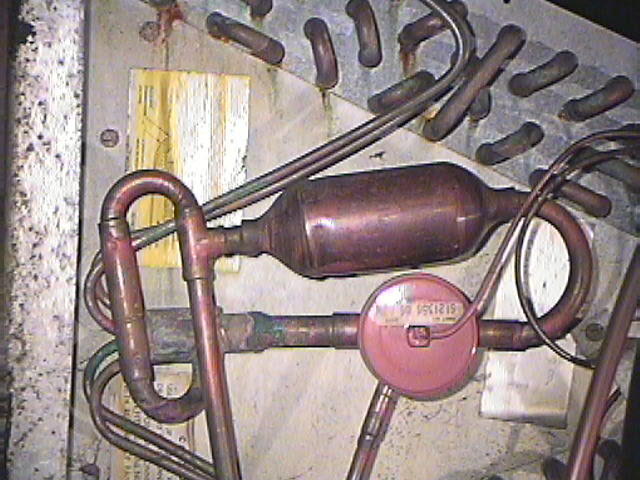
Image of Rheem/Ruud heat pump
indoor coil with thermostatic expansion valve (cooling mode). A system that
doesn't have one of these inside (cooling) and out (heating) cannot be the best
that it can possibly be.
Changing the indoor coil to one like this can bring new
life to an older malfunctioning system and it can work better than a new one
that doesn't have this feature. We have found that most cooling problems start
with a dirty or undersized indoor coil that you can't see than the outdoor unit
that you can see.
My partner Gerald has a flattened stack of
indoor coils piled to the ceiling of the garage but no replaced outdoor units.
In the last 3 years we have replaced no outdoor units but have a pile of leaking
or very dirty indoor coils. What does that tell you?
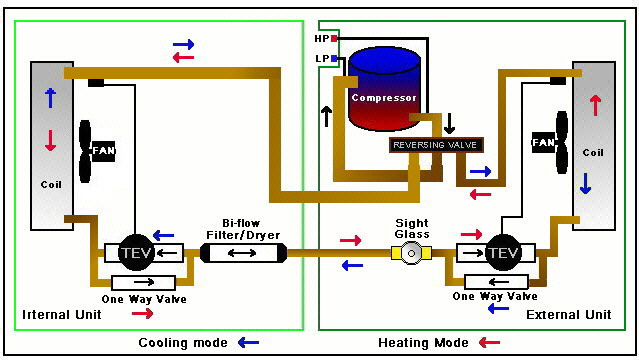
This image of a heat pump
TEV/TXV scheme was donated by 4Z5AY. The only technical change would be the
connection on the left should look like the connection on the right and there
would usually be a Bi-flow (heat pump) Filter Dryer to the left of the sight
glass not individual dryers.
The suction pressures shown are for cooling
mode. Heating mode will be lower. Head or high pressures will be similar from
heating to cooling. One of the methods of charging that I have read about that
seems to make sense when explained properly is to add charge as long as the
suction line keeps getting colder as soon as it starts to show low super heat (I
will explain that later) then there is too much refrigerant; you don't want to
flood the compressor or run the head pressure to high. What I usually do on a
system that is not a TEV/TXV. is to charge until the suction pressure gets above
55-60 psi then add more until the suction line starts to get cold. remember more
efficient systems will have higher suction pressures (80 psi is not uncommon). I
also watch my head pressure to make sure there isn't other problems (175-225 is
good depending on the condition of the outdoor coil, anything above 250 is cause
for concern). If the pressure is above 300 then there is definitely something
wrong like a very dirty coil or the system is simply overcharged. The compressor
(hermetics {piston} not scrolls or rotary) will have a ball of sweat around
where the suction line enters, what Mr. Forest Grauel calls a "happy
compressor". If the compressor becomes a ball of sweat then the system is
feeding too much refrigerant into the indoor coil. If it is dry then there is a
restriction (suction pressure will usually be low; below 40 psi cooling mode and
ice will start to grow).
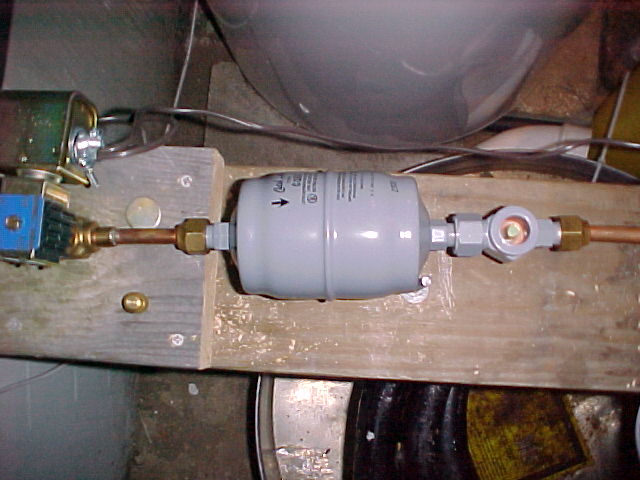
Image of a sporlan sight glass
connected to a filter dryer after a liquid line solenoid valve. When the sight
glass is clear like this the system is fully charged. Adding any additional
refrigerant will just back up into the condensing coil (outdoor in cooling mode,
indoor in heating mode) If the suction pressure is still low and the refrigerant
is not feeding properly then you have a problem with the metering devices.
Adding this device is the easiest way to diagnose a problem system.
If your system has the refrigerant out for
any reason; add one of these before charging. You will thank yourself 100 times
over.
Please also See the page on icing. Which is
closely related!!!
What is "Superheat"?
You will hear and see this term all the time in
reference to refrigeration. Simply put it is the difference between the
temperature of a vapor line in relation to the temperature scale on a pressure
gauge for a particular refrigerant or how much liquid is feeding the evaporator
in relation to how fast it is being boiled off. for example (R22) if the suction
gauge reads 70 psig then the evaporating temperature is 41 degrees but if
the tubing is 51 degrees then you have 10 degrees of Superheat. A typical range
for residential air conditioning is 12-18 degrees with some error based on
extreme conditions. Once you understand Superheat you can diagnose obvious
problems. For example a system that is under charged or has a stuck (closed)
metering device will have high super heat (over 20 degrees) at the compressor
and a system that is grossly overcharged or has a dirty indoor coil can have
very low Superheat about 3-7 degrees with low suction pressure and the suction
line will be very cold.
The following conditions are for R22 in the
cooling mode and relate to indoor coil problems which contrary to human
nature we find to be 80% of the reason for poor cooling.
Human nature says that the Thermostat is
"where is all comes from" and if you can just get a new enough outdoor unit with
the right brand name everything will be ok, B.S!
My own unit is a 30 year old GE with a Trane
compressor and the original air handler. The system cools great and in the
heating mode the air comes out very hot even when it is very cold outside and
the heat pump does this without the benefit of the electric heating elements.
The point is that if I can make my 30 year old GE work this well then imagine
what I can do for your newer system or your system in general.
I will have to make a chart for outdoor coil problems. The goal
for outside is to get a full liquid line and the head pressure as low as
possible. On a newer unit 190-225 PSI of head is normal, on some older units
(20+ years) 300 PSI of head on a 90 degree day is not out of the question and be
normal. Anything higher wash the coil and consider the unit may be
overcharged.
*Warning: There are situations where due to
the conditions of you system you may have lower than normal suction pressure
and/or higher than normal head pressure. Usually lower than normal suction
pressure and any attempts to raise the suction pressure will result in
overcharging. The trick is to determine if this pressure is normal for this
system, which is usually caused by airflow problems. For example some systems
with low air flow, 50-55 PSI is normal. The secret to being a good mechanic it
to determine if this is a normal pressure and leave it alone.
Normal Superheat
Normal suction pressure |
Suction pressure 65-80 psi
8-15 degrees superheat. depending on
size of indoor coil, air flow and condition.* |
Head pressure 190-225 on newer units 300 not out of the question on an
older unit on a 90 degree day. |
Full liquid line, sight glass will be clear, compressor will draw near
rated current (NEVER charge by current
draw). |
| Low super heat low suction pressure |
Dirty indoor coil, no or poor air flow. |
Coil will ice up quickly. One of the most common problems! |
3-7 degrees superheat suction pressure 35-40 psi Suction line will
freeze out to to the compressor. Compressor will be ruined because of oil
dilution. |
| Low super heat higher than normal suction pressure |
Over feeding refrigerant or overcharged |
If overfeeding head pressure will be slightly lower than normal if
overcharged head pressure can be sky high. |
65-80 psi 5-10 degrees superheat. |
| High superheat lower than normal suction
pressure. |
Refrigerant not feeding properly. |
Could be slightly undercharged or a problem with the metering device.
If overcharged head pressure can be sky high. |
40-60 psi suction. 18-25 degrees superheat. |
| High superheat very low suction
pressure. |
Refrigerant not feeding at all |
Could be almost out of refrigerant. compressor will overheat and be
destroyed. |
20-40 psi
Compressor will get very hot and shut off on internal
protection. |
| Low super heat high suction pressure. Lower than normal head
pressure. |
Compressor is not pumping properly. Or possibly metering device is
missing or stuck open. A heat pump check valve (indoor coil) is blown. |
Replace compressor. Check for open metering device or blown check
valve. |
Compressor will be flooded.
80-100 psi. Pressures will equalize
almost instantly |
This page will be continued later:
Scott Meenen can be reached at 301-591-1646
Click here to
return or go to the home page:
For a list of all the pages on
this site go to the site map.
Please
bookmark for future reference
Written By: Scott Meenen
N3SJH of
G&S MECHANICAL SERVICES.
Serving Maryland, DC, and Northern
Virginia.
Contact us
Email us at: mailto:jsmeenen@toad.net?subject=charge
response from webpage
Specializing in Mechanical, Controls and Electrical Modifications
Of
Heating, Air
conditioning, Refrigeration, Cold storage,
Ice Production and Food
preservation.
Anything having to do with Heat and Energy.
We service and repair the following brands:
American Standard, Amana, Arco, Arco-Air, Bryant, Carrier,
Coleman Evcon, Comfortmaker, Day/Night/Payne, Dunham-Bush, Fedders, Fredrich,
Goodman, General Electric, Hotpoint, Heil, Intertherm, Janitrol, Kenmore, Lennox
(Armstrong, Johnson Air-Ease), Miller, Modine, Nordyne, Rheem/Ruud, Sears,
Stewart Warner, Trane, Williams, White-Westinghouse, Whirlpool, Weil Mclain,
York, (Frasier Johnson/Borg Warner) and others.
MARYLAND DC. VIRGINIA
AREA
BACK TO
TOP