|
|
 |
Click on the book covers for AUDIO FILES, list of topics and sample pages |
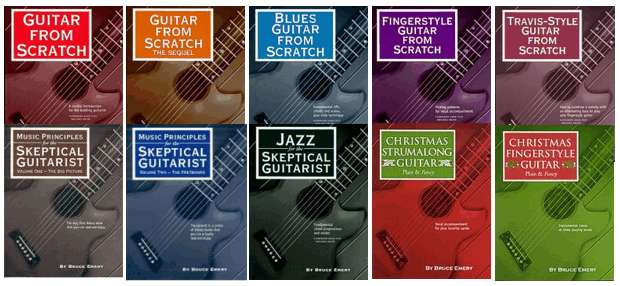
My name is Bruce Emery. I'm the author and publisher of the Skeptical Guitarist and Guitar From Scratch series. And I think I've developed a truly radical approach to teaching both the theory and practice of the guitar, something no one's ever tried before: I use Plain English and Simple Diagrams. What
a concept! Instead of trying to impress you with my own knowledge, I
thought it might be nicer to help you enhance yours. The Skeptical
Guitarist books dwell on the THEORY, the whys and the wherefores, while
the Scratch books present the PRACTICE, the mechanical aspects of
physically playing the guitar. Here are brief introduction to these two
complementary series, plus a peek at my two Christmas books: |
 Guitar From Scratch
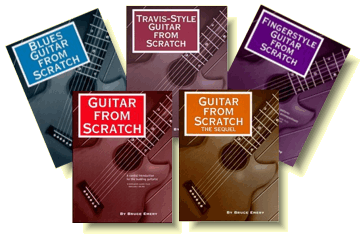
 In the first Scratch book, there is a smattering of theory here and there, but first things first. This is where you’ll learn to finger the most common simple chords and to switch back and forth between them in a timely fashion. Along the way, it might be nice to see which chords group together in different keys and how to strum and fingerpick these chords using examples from popular music.
In the Sequel, we’ll look at some guitar vernacular (or common speech), work our way toward incorporating single-note playing into chord playing and then examine techniques for playing single note lines and melodies by themselves, touching on Major Scales and improvising on Pentatonic Scales. Then we’ll devote some time to learning to read Standard Music Notation for the guitar. It is the universal language of music and even guitarists can benefit from identifying and tracking down notes from the Musical Alphabet on the fretboard. Besides, you won’t find a more painless approach than the one I’ve got worked out.
You like fingerpicking? We’ve got fingerpicking, in the third book, starting with the most basic tools and concepts and working up to full fingerstyle accompaniment parts for some popular songs. The first part gets you playing arpeggios (broken chords) and the second part introduces specialized arpeggios known as Travis-Style picking patterns. I just know you’ll love it.
There is not a guitar student on earth who doesn’t want to learn some BLUES. The fourth book starts you off in grand style, with easy licks you can play whether you want to sing or not. For the electric blues player, we go on a tour of the fretboard in search of the best pockets of notes for improvising. And you can also try your hand at playing slide guitar.
Travis-Style guitar is a fingerstyle technique where you play a melody line over an independent, alternating bassline. I’ve devoted the second half of Fingerstyle Guitar From Scratch to teaching the simpler form of Travis-Picking, using picking patterns to accompany the voice, but here we learn to incorporate the melody itself to create instrumental versions of songs. Think Merle Travis, Chet Atkins, Leo Kottke, John Fahey and Mississippi John Hurt, to name a few of the many practitioners. Experienced players may find some challenges toward the end.
Guitar From Scratch: Streamlined Edition
 This
new book is intended for guitar teachers and their students, in both
group and private settings. The information, condensed from other
titles in the Guitar From Scratch series, is presented here in a more
direct manner with less detailed explanation. The text has been
stripped down to the essential information, so the teacher has room to
put his or her own personal stamp on the material. This book
uses chord diagrams and tablature to get the student playing easy
material ASAP: chords first, some strumming and fingerpicking, then on
to melodies, basslines and scales, and even introducing 12-Bar Blues
and some basic blues improvisation.
This
new book is intended for guitar teachers and their students, in both
group and private settings. The information, condensed from other
titles in the Guitar From Scratch series, is presented here in a more
direct manner with less detailed explanation. The text has been
stripped down to the essential information, so the teacher has room to
put his or her own personal stamp on the material. This book
uses chord diagrams and tablature to get the student playing easy
material ASAP: chords first, some strumming and fingerpicking, then on
to melodies, basslines and scales, and even introducing 12-Bar Blues
and some basic blues improvisation.
 Music Principles for the
Skeptical Guitarist:
As a guitar teacher here in Raleigh, NC, I had spent a fair amount of time searching for a comprehensive, easy-to-read, user-friendly treatise on music theory written specifically for the guitar. Failing in that effort, I set about the task of trying to come up with something myself. The Skeptical Guitarist series is the fruit of that labor.
I have tried to design a series on guitar music theory that is as much of a "page-turner" as possible, given the technical nature of the subject matter. Sort of a story-telling approach. You and I will travel together through the unfolding musical landscape. You'll find a variety of examples, exercises and worksheets to help you reinforce what you think you understand. And I promise not to confuse you, bore you or irritate you.
My approach is to start with the familiar---and to stay there for a long time! Then we can move gradually to the knottier concepts and examples, always harking back to those simpler times. Too much jargon is never a good thing; as I said before, English, please. And I try to convey my own sense of fascination with how it all fits together.
Briefly, Volume One, The Big Picture, lays the groundwork: scales, chords and the Great and Powerful Circle of Fifths. Volume Two, The Fretboard, places these scales and chords all around the neck and shows you how to construct fancy Chord Qualities all by yourself. Jazz for the Skeptical Guitarist goes on to explain the most important jazz chord progressions and gives you a handle on how to start improvising your own solos.
 |
Christmas Strumalong Guitar: Plain and Fancy Christmas Fingerstyle Guitar: Plain and Fancy I know that there are millions of Christmas books out there, but not so many that (1) are designed specifically for guitarists and (2) have more than one version of each carol. The Strumalong book has just enough information for you to be able to lead a group of carrolers: lyrics, chord symbols (with timing), chord diagrams, starting notes and strumming and fingerstyle patterns. It even has lyric sheets in the back that you are free to copy and distribute. And it has two versions of each carol, the Plain one (bare bones) and the Fancy one, where the chords are more various and the changes more frequent. |
The Fingerstyle book is presented in
Tablature, and there is a 20-page tutorial, called Fingerstyle 101, if
you need it. Then each carol is presented at three different levels of
difficulty, so no matter what your degree of prowess on the guitar,
you’ll be able to play SOMETHING. Level One can even be played using a
pick if you have no interest in fingerpicking. Level Two arrangements
are more colorful, incorporating basslines, arepggios and new harmonies,
and then Level Three is just…..moreso. I always warm up with Level Two
before tackling Level Three.
To learn more about my musical offspring, click on!
Five Reasons to Consider Buying These Books (1) Continuity. I offer a spoon-fed, step-by-step approach. There is a steady flow of information, rather than the Hit-and-Run School of Thought. No gaps, no loose spots, no quantum leaps. (2) Clear Page Layout. I’ve tried to design each page to be inviting to the eye, and not clogged with information. Paragraphs are short and the margins are contoured so that the eye is swept along from line to line. Thoughts and sentences never spill over onto the next page. (3) Simple Notation. Instead of relying on Standard Music Notation (the dots, beams and flags), I prefer to emphasize the language of the guitar itself, Fretboard Diagrams: simply pictures of which strings to hold down at which frets. Both Tablature and Standard Notation are presented when they are useful, but anyone can read a Fretboard Diagram; it’s just a map of a piece of the neck of the guitar. (4) Friendly Exercises, Examples and Diagrams. This is the heart of the matter. We learn best by doing, so I’ve included straightforward educational activities along with easy-to-read graphics. (5) Coil Binding. The books lie flat when you place them on a table or music stand---a major selling point for some! In short, I’m not sure what I could do to make this material any clearer, more comprehensive or more fun to read. |